ER, IR, and UR are the sneaky trio of r-controlled vowels. They all make the same sound — /ɜːr/ — but three completely different spellings. Your students can say "bird," "fern," and "surf" without thinking. Getting them to spell those words correctly, and to decode them instantly on the page, is a different challenge entirely.
That challenge takes repetition. Not busywork repetition — meaningful reps where students are decoding real words in context, getting quick feedback, and moving on. The Spirit Evolution Board Game was built specifically for that.
What Is the Spirit Evolution Board Game?
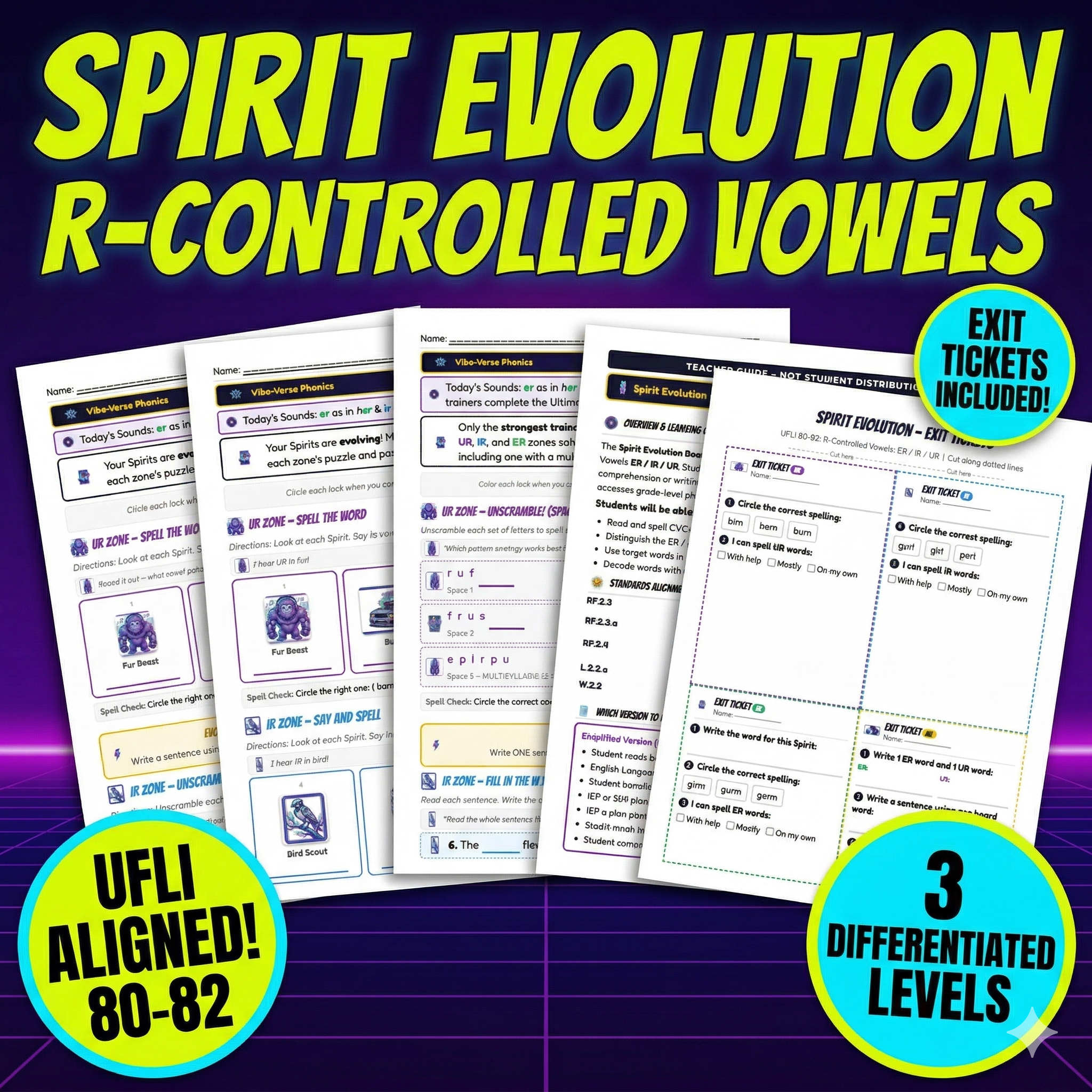
It's a printable board game where students guide anime-style Spirit Cards through three zones: the UR Zone, the IR Zone, and the ER Zone. Each zone has phonics tasks — spelling words, unscrambling letters, filling in blanks — and between zones there are Evolution Gates where students must write a sentence using target words to advance.
The game runs 20–30 minutes and gives students 30–40+ decoding reps without ever feeling like drill work. Because they're playing. Because the Spirit Cards have names. Because passing an Evolution Gate feels like an actual achievement.
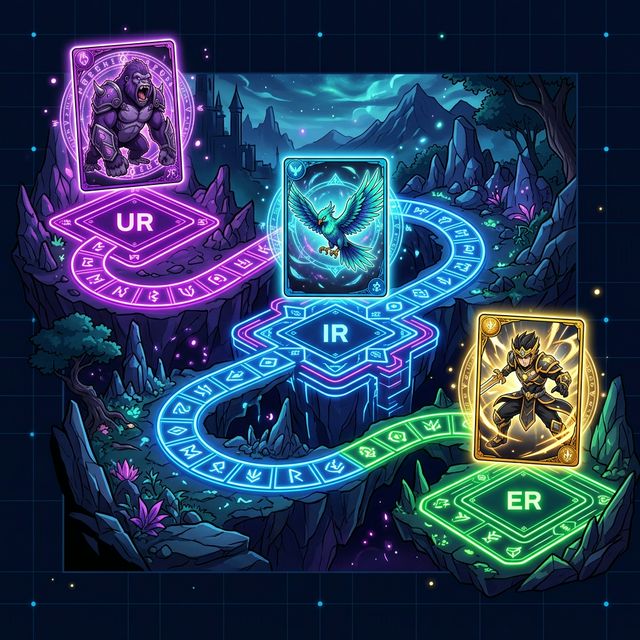
The Three-Zone Structure for R-Controlled Vowels Practice
Most phonics activities lump ER, IR, and UR together and ask students to sort or identify them. That's a fine skill — but it's not the same as being able to produce each pattern when you need it.
The Evolution Board game takes a different approach: each zone isolates one pattern at a time. Students spend multiple spaces on UR words before they hit the Evolution Gate and cross into the IR zone. By the time they reach ER, their brain has already processed the previous two patterns enough to handle the contrast.
That zone structure also mirrors the UFLI Foundations Lessons 80–82 sequence — UR is introduced first, then IR, then ER — so the game reinforces the same order your explicit lessons follow.
The 6 Versions — and How to Choose the Right One
This is where the game gets genuinely useful for mixed-ability classrooms. There are six versions total — three difficulty levels, each in color and black-and-white.
Simplified Version (Color + B&W)
The Simplified version is for your students who are still building confidence with the patterns. It focuses on accessibility and early success:
- 8 target words instead of 12
- Dyslexia-friendly font (Lexend, 18pt)
- Picture-match spelling — students see a Spirit Card image and say the word before they write it
- Word bank available on every page
- Pre-filled sentence frames at the Evolution Gate rather than open-ended writing
Use this with: students reading below grade level, ELL students who are still building vocabulary alongside phonics, students with IEPs targeting phonics at a phoneme/grapheme level, or any student who needs the task to feel achievable before it feels challenging.
Standard Version (Color + B&W)
The Standard version is your core intervention tier. It uses 12 target words across the three zones, with three different puzzle types: spelling from the Spirit Card image, unscrambling letters to spell the word, and filling in blanks in sentences. Two Evolution Gates ask students to write sentences using three target words each.
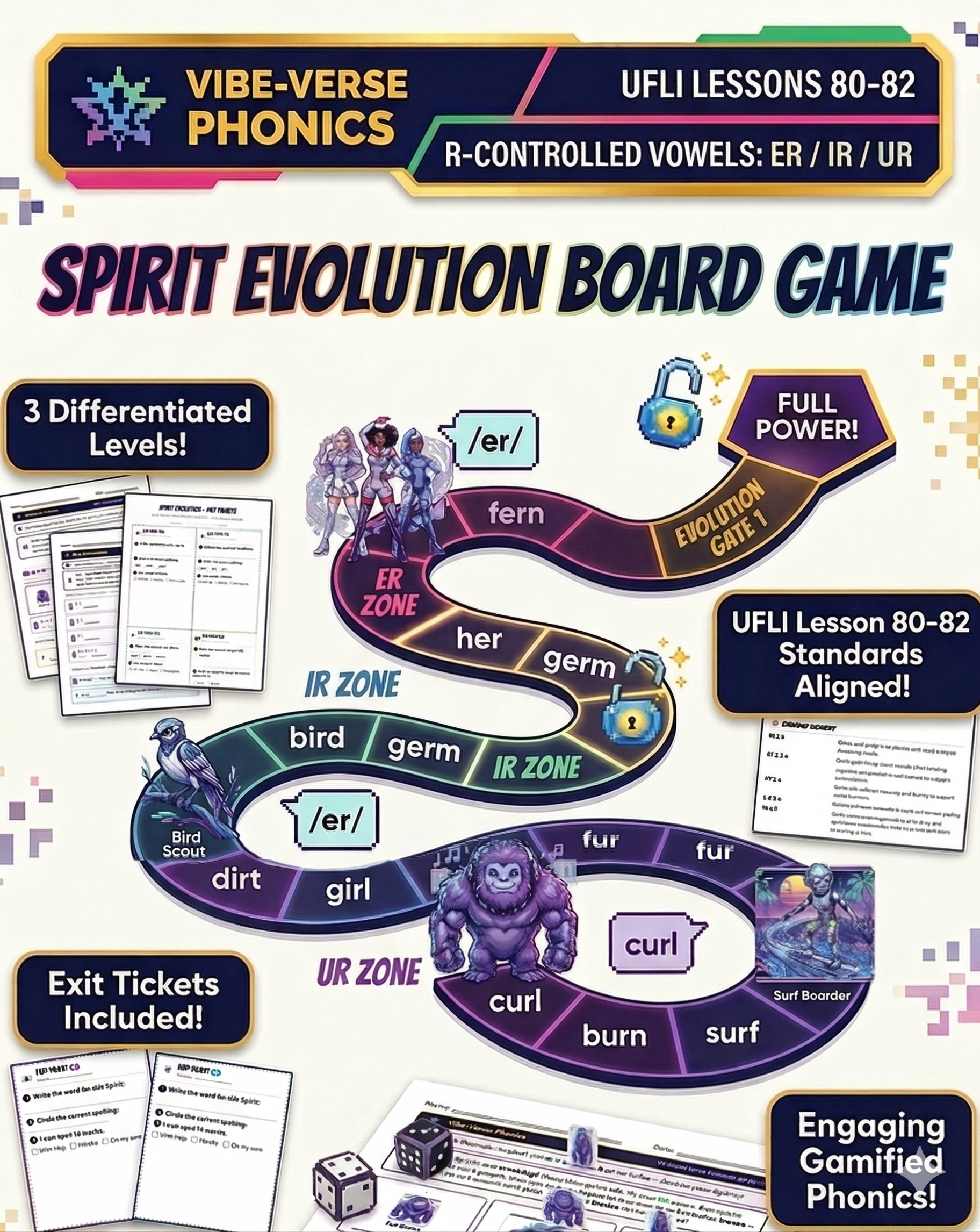
After the board, there's a decodable reading passage — "The Spirit Evolution" — where ER, IR, and UR words are color-coded directly in the text. Students circle them by color, count them by pattern, and answer a vocabulary question. Then a writing extension with three sentence frames.
Use this with: students at grade level who need systematic phonics practice, small group intervention at Tier II, or any student who can decode most words but hasn't built automaticity yet.
Challenge Version (Color + B&W)
The Challenge version is for students who have the basic patterns but need to be pushed. It completely removes the word bank and increases the rigor:
- 16 words — including multisyllabic words like butterfly, birthday, and perfect
- Definition matching alongside unscrambling and fill-in-the-blank
- Three Evolution Gates, including one that requires using a multisyllabic word in a sentence
- A four-sentence story "boss challenge"
- A bonus cut-and-paste word sort with 16 word cards and four deliberate trick words (like were — does that count as ER?)
Metacognitive reflection questions at the end ask students to identify which pattern is hardest for them and what strategy they use.
Use this with: students reading above grade level, students who've mastered basic ER/IR/UR and need extension, or as enrichment during small-group time.
The Assessment Tools That Come With It
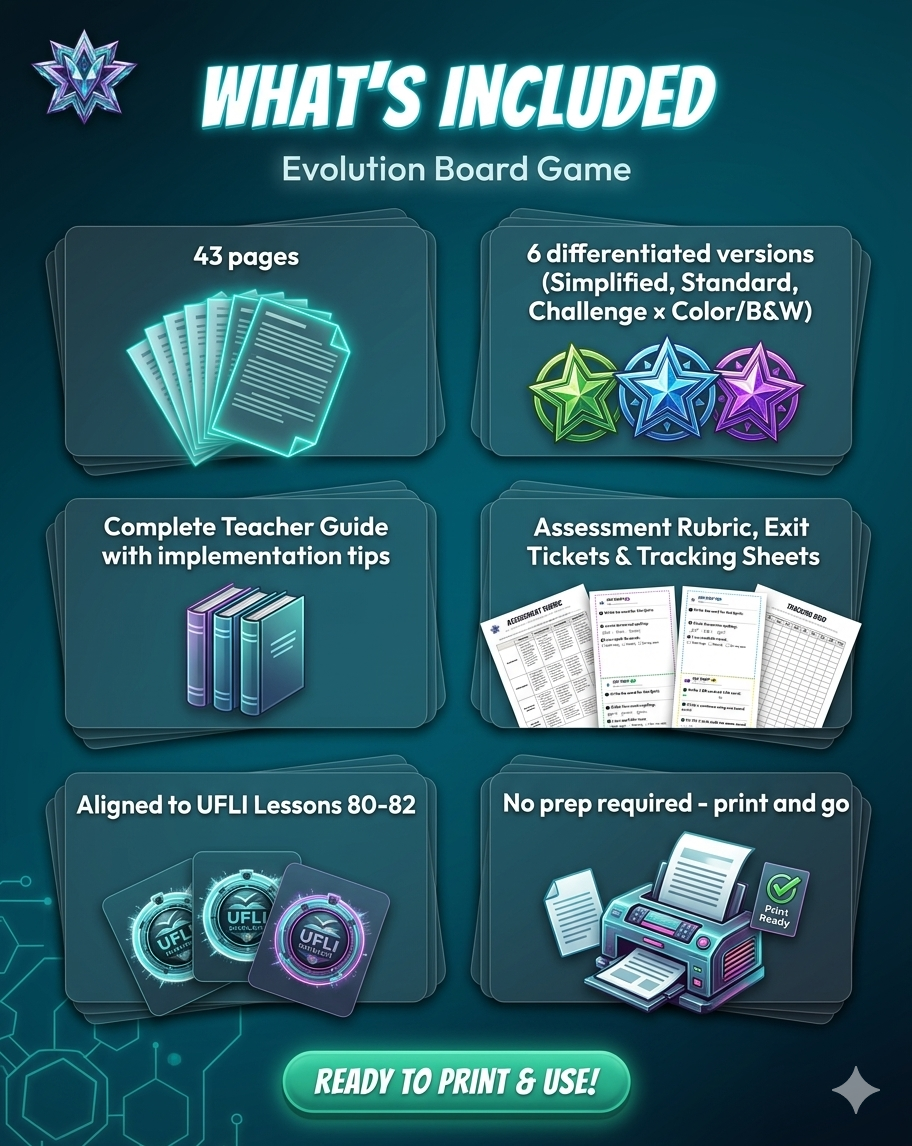
The 43-page package includes a lot more than the game boards. Here's what else you get:
- Teacher Guide (2 pages) — step-by-step instructions for each version, a differentiation decision tree, and common ER/IR/UR misconceptions to watch for
- Welcome/Overview page — a version comparison table and Quick Start Guide so you can hand the package to a paraprofessional or sub without a long briefing
- Answer Keys — covering all puzzle types across all three versions, including the reading passage comprehension tasks and the Challenge word sort
- Rubric — 4-category scoring (Spelling Accuracy, Sentence Writing, Reading Fluency, Strategy Use) across four performance levels
- Exit Tickets — 4 per page in color and B&W. Each ticket has a spelling task, a pattern discrimination task (circle the right spelling: germ / girm / gurm), and a self-rating. Quick to administer, quick to grade
- Progress Monitoring — a class tracking grid with 25–30 student rows, six date columns, and score columns for each zone (UR/IR/ER). Tracks repeated practice without reprinting
- Tracking Sheet — individual student version with a self-assessment column per attempt
If you're in an RTI or MTSS framework and you need documentation, the exit tickets plus tracking sheet give you what you need. If you just want to run a great center and go home, you can ignore all of that and just print the game board that matches your students' level.
Three Classroom Setups That Work
1. Small Group Intervention (20 minutes)
Run the Standard version with 2–4 students who need the same level of support. Let them take turns rolling a die and moving their game pieces, completing the phonics task on each space before they can stay. Evolution Gate moments become genuinely exciting — students want to write a good enough sentence to pass.
While they play, you observe. Who hesitates on UR words? Who writes "germ" without thinking? Who guesses on the unscramble instead of working it out? You'll collect useful data without a single formal assessment.
2. Literacy Center (Independent)
A laminated game board with dry-erase markers means one print runs indefinitely. Students work through the board with a partner, writing their answers on a separate answer sheet.
After the first session, model the routine once and students can run it themselves. That frees you to work with other groups.
3. Differentiated Whole Class (30 minutes)
Print three sets: Simplified for your Tier II/III students, Standard for grade-level, Challenge for enrichment. Give students the version that matches their current level. All three groups are working on ER/IR/UR — just at different depths.
When you bring the class back together, the debrief is organic: "Which Spirit was hardest to spell? What pattern did it use?" Students from all three versions can answer, and the conversation connects the levels without highlighting who was working at which difficulty.
The Spirit Evolution Board Game — 43 pages, 6 versions, no prep.
Print the version that matches your students. Everything else is included.
Get It on TpT → $4.00Also available as part of the Vibe-Verse MEGA Bundle — save 40%.
A Note on the Spirit Cards
The Spirit Card characters in this game — Fur Beast, Bird Scout, Surf Boarder, Her-o, Germ Blob, and others — are the same characters in the Vibe-Verse card game. If a student plays the board game and then encounters "Bird Scout" in a card game session, that name and that /ir/ pattern are connected. Cross-activity repetition like that is exactly what builds lasting orthographic memory.
The board game is a standalone activity. But it fits into a larger system if you want it to.