The Engagement Problem No Phonics Program Talks About
A student sits down at a guided reading table. The decodable text in front of him features a boy named Tim, a dog named Pip, and a red ball on a mat. He is seven years old, fluent in Mandarin, and spent the entire car ride to school this morning explaining to his father why Charizard loses to Blastoise at Level 40. He picks up the book. He reads the words correctly, because he can decode them. Then he closes it and stares at the wall.
That moment is not a motivation problem. Call it one and you will solve the wrong thing.
Standard phonics materials were built with a specific child in mind — one who arrives at school already familiar with the characters, the settings, and the cultural shorthand embedded in the illustrations. In international schools with large populations of students from Chinese and Korean families, that assumed background simply does not exist. The cartoon dog and the suburban backyard are not neutral. They are a context, and for a significant portion of students in the room, that context signals before the first sentence is read: this was not made for you.
Culturally responsive phonics instruction starts by taking that signal seriously. Not with a guilt spiral, and not with a curriculum overhaul. But with an honest look at what early readers are actually bringing through the door every morning — and whether the materials in the room are built to receive it.
What Students From Every Cultural Background Already Know (And How Phonics Programs Ignore It)
When you spend time watching Grade 2 students arrive at an international school, you notice something quickly. These kids are not disengaged. They are intensely engaged — with each other, with systems they have chosen, with competitions they have invented. Before the bell rings, they are already deep in negotiation over card trades, already tracking which characters counter which, already applying a surprisingly sophisticated understanding of rules and sequences.
That is not recreational noise. That is instructional capital sitting on the floor of the hallway.
Co-planning in a culturally diverse classroom means asking a different question than most phonics programs ask. Instead of asking how to deliver the sequence, the question becomes: what structures do these particular students already understand deeply, and how does the phonics sequence map onto those structures? The prior knowledge is already there. The job is to build a bridge to it, not to wait for students to find their way across on their own.
For the students described above, the bridge is obvious once you look. They already know how card mechanics work. They already trust the loop of collecting, comparing, and using. The question is whether phonics instruction is willing to meet them inside that loop.
Worth saying plainly: designing from that question does not produce materials that only work for students from one cultural background. It produces materials that work better for every early reader in the room. Reduced cognitive load, consistent characters, familiar structures — these are not accommodations for a subset of students. They are good instructional design, and the whole class benefits from them.
Why Card Mechanics Work for Phonics Practice
The Science of Reading is not a single study — it is a body of converging evidence about how skilled decoding develops. Two principles from that evidence base are especially relevant here: retrieval practice and spaced repetition. Students consolidate phonics patterns not by seeing them once and moving on, but by encountering the same patterns repeatedly across varied, low-stakes contexts.
Repeated retrieval practice produces better long-term retention than a single study session, even when total study time is held constant. — Roediger & Karpicke, 2006
A well-designed card mechanic does exactly this without the student noticing. Every time a card is played, traded, or compared, the student reads the target pattern again. The repetition is embedded in the activity itself. There is no separate drill. The game loop and the phonics loop are the same loop.
This is why phonics card games work for K-2 learners in a way that worksheets frequently do not — and it has nothing to do with making learning "fun" in a vague, decorative sense. It has to do with the structure of the practice. The card mechanic generates repeated low-stakes exposure automatically. Students do not tolerate the repetition; they seek it, because the repetition is the game.
For early readers from any cultural background, there is an additional layer. When the card system uses characters and imagery that feel familiar and chosen rather than assigned, the affective barrier to engagement drops before the decoding work even begins.
Consistent Characters Across Materials Are Not Just Aesthetic
Cognitive load theory has a practical implication that sometimes gets lost in curriculum design: when working memory is occupied with orienting to new characters, new settings, and new visual languages, there is less capacity left for the actual decoding work. Familiarity is not a luxury. It is a scaffolding decision.
When students meet the same characters in their decodable texts, in their card sets, and in their game mechanics, something useful happens. The characters become anchors. The student is not spending cognitive effort asking who these figures are and whether they are worth caring about. That question was answered ten cards ago. Working memory is freed up for the phonics pattern itself.
For students navigating a new instructional context, consistent character design across materials also reduces ambiguity. The familiar face on the card and the familiar face in the reader are the same signal: you already know how to do this part.
How Spirit Phonics Adventure Was Built From This Observation
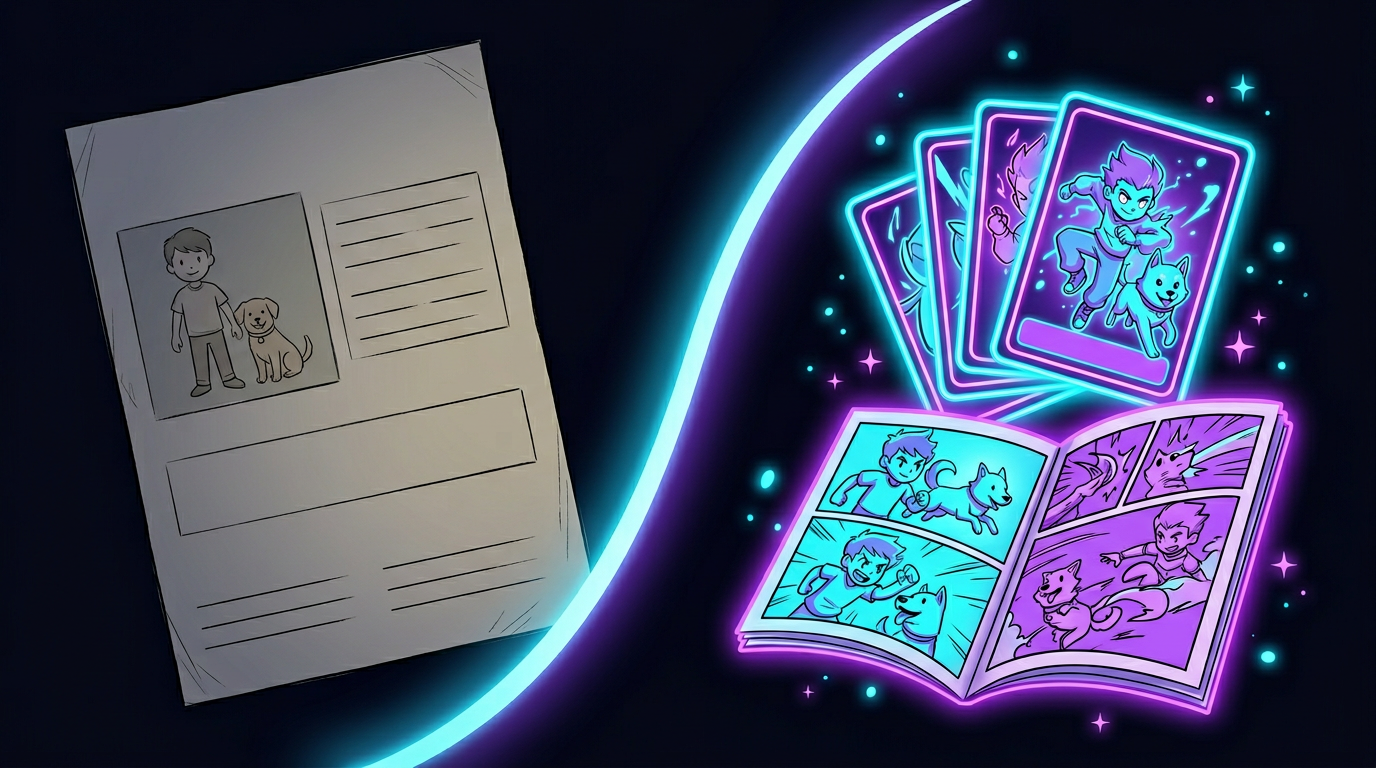
Spirit Phonics Adventure grew directly from watching students trade cards at recess and recognizing that the instructional mechanic was already in the room. The system was not built by adding a game layer to an existing phonics worksheet. It was built by starting with the card-trading structure students already understood and mapping a rigorous, UFLI-aligned phonics sequence onto it from the beginning.
UFLI-aligned phonics activities follow a structured literacy progression — systematic, explicit, and cumulative. Spirit Phonics Adventure works within that sequence. The characters and Spirit Battle mechanics are not decoration applied over the phonics content; they are the delivery system for it. Students collect characters who correspond to specific phonics patterns. The battles and trades require them to read and apply those patterns. The decodable texts in the series feature the same characters, so the cognitive work of decoding is happening inside a world students have already chosen to inhabit.
The character designs were built deliberately to travel across cultural contexts — not to be racially coded in any single direction, and not to reproduce the suburban-Western visual default that defines most early literacy materials. For Science of Reading implementation in international schools, that design decision is not incidental. It is the whole point.
What Meeting Students Where They Are Actually Requires
Cultural responsiveness in phonics instruction is not a philosophy statement. It is a design constraint. It means that the cultural entry point and the phonics sequence cannot be separate layers — one added on top of the other. If the K-pop wrapper is just decoration on the same worksheet, students will see through it in about thirty seconds, because they know the real thing and they know a copy.
What actually works is building the system so that the thing students already love doing is the phonics practice. Not adjacent to it. Not a reward for finishing it. The same activity.
The concrete move you can make tomorrow: bring one phonics activity you are planning this week to your next co-planning conversation and ask what the students in your room already do fluently and enthusiastically outside of school hours. Then ask whether the structure of that activity — not the surface content, the actual mechanic — maps onto the phonics practice you need them to do. Trading, collecting, comparing, competing, building. Those structures are already in the room. If you are planning alone, ask the question anyway. But it lands differently when the person across the table has also watched the same kids negotiate card trades in the hallway and recognizes immediately what you are pointing at.